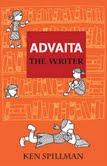

A story of separation, of belonging, of space, of identity, of dreams, of inspiration
THERE is something irresistible about the book, Advaita the Writer, by Ken Spillman. It's not just the story, the characters, the setting, the language or the structure. It's something else, something less conspicuous, like the roots of a tree buried deep inside. Sometimes it's the turn of a phrase, sometimes it's the shape and contours of Advaita's mind, sometimes it is the clash of the adult world and the adolescent world, but always it is there. That something which makes you want to reread and relive the story, breathing in Spillman's sheer genius.
Advaita the Writer is many stories rolled into one. It is the story of separation, of belonging, of space, of identity, of dreams, of inspiration, each an intrinsic aspect of growing up. Right from page one, we are pulled into Advaita’s unique world, as she readies herself to leave for the Dunham Girls' School in Dehradun, venturing from the familiar to the unknown. Her first experiences at school, her loneliness and fear, her yearning for home, her inevitable withdrawal into the world of books and ideas, and the natural evolution of her thoughts revealed in her letters, makes every single nuance of her character real and tangible. So when she discovers that her favourite author, Ruskin Bond, lives in Dehradun, breathing the same air as she does, the disbelief she feels is palpable, as is the awe she goes through when she actually meets him. And when she is finally at peace with her situation, you feel calmer too, finding comfort in the sanguinity of life that Advaita discovers in the end.
What keeps this delightfully unpredictable world of Advaita aloft is Spillman’s narrative. It flows like a happy river, meandering through difficult emotions and exciting metaphors with equal ease, as it runs its preordained course. Throughout the book, Spillman gently pushes the boundaries of language, never once compromising on the intelligence of the reader or taking it for granted. It’s a delicate balance that is rarely achieved in books for young readers.
The illustrations by Menon too are spot on, hovering, almost respectfully, behind Advaita’s story. Read this book to be touched by not just the magic of Ruskin Bond, but also that of Spillman’s through lovely, whimsical Advaita.
Comments
Review submitted for LRSI - '14
“Advaita the writer” a children book written by Ken Spillman is an interesting book which showcases the feelings and emotions of a young teenage girl. The story revolves around the journey of a girl who is sent to a boarding school in the beautiful valley of Dehradun.
Advaita is an intelligent and a loving girl who is very fond of reading books. She is a loner by nature and does not like to mix around with other girls and finds respite in the well equipped library of her boarding school. She finds comfort in the library and idolizes the famous children books author Ruskin bond, her happiness is tremendous on learning that her favourite author resides just a stone’s throw away from Dehradun. This information now fills her with a new enthusiasm for not only reading but writing as well. Her imagination takes a new direction and before long her stories and poems begins to appear in the school magazine “chrysalis”.Finally she gets to meet her idol Ruskin Bond who realizes that loneliness has made her a writer as Advaita puts her feelings on paper as stories and poems When finally Advaita reads his autograph which says” from one writer to another” her life gets a new direction and she decides to be an author.
This book is appealing in all aspects whether it is the interpretation of characters, simple language, flow of the story or the description of the scenery and emotions. It relates the journey of Advaita from her well protected home to her boarding school, her loneliness, and her letters to her parents showing her sense of humour, her dreams, her imagination and finally her awe at meeting Ruskin Bond in real self. The book involves one completely and it is so engrossing that we can read it not once but many times .
The illustrations also help to keep a reader involved in the book.
Kanika Chadha
V B
Arya Vidya Mandir (E)
Advaita The Writer is a
Advaita The Writer is a delightful book. Period. I can go on to tell you why, and I would be delighted to do so. I just thought that I must tell you about how I liked it in the beginning.
Australian writer Ken Spillman tells the story about a young Delhi girl Advaita who leaves to go to boarding school in Dehradun. He tells us about the wonderful world of words and about young Advaita who escapes into them. He sets his book in India, mostly Dehradun, like a proper Indian would.
The book is about Advaita, the elder of two sisters. I found it interesting because Spillman who is an Australian describes India as an Indian would. In the conversation between Advaita and her sister, the sights, sounds and smell of New Delhi Railway Station and even in the drive from Dehradun to Mussoorie.
I also like the way the words sound. 'Click-clack. Way off track' makes me feel like I am in the train. 'a big Vide Vorld of Velcro. Vot an idea!' makes me feel like I am in the grassy fields of Switzerland.
The book ends with Advaita meeting Ruskin Bond, her favourite author, who signs her book 'From one writer to another'. Which I liked a lot. My favourite thing about the book, is the part where Advaita escapes into her Dreamland and lives among her ideas. I guess, it's because I do it too.
Kyra Roy
Std 3 A
Arya Vidya Mandir Bandra West